Sourcing plant-based proteins from China is not simply a matter of finding the lowest price per tonne. A buyer must match protein content, functionality, flavor, processing method, and documentation to the finished food. The USDA Foreign Agricultural Service’s Production, Supply and Distribution database estimates China’s soybean imports at roughly 105 million metric tons in the 2023/24 marketing year. That scale signals a deep supply base, but it does not mean every shipment is suitable for human-food ingredients. Much soy is crushed for oil and animal feed. Important distinction.
For teams researching how to source vegetal proteins for food production, the first practical step is to define the ingredient specification. Isolate or concentrate? Neutral flavor, or a toasted note? A sample that performs well in a glass may behave differently in a protein bar or meat analogue. Ask suppliers for recent certificates of analysis, allergen statements, processing details, and lot-level traceability. Then test samples in the actual recipe. On paper, suppliers can look alike.
Patrick Brown, founder of Impossible Foods, has described his company’s ambition as to “make meat obsolete.” That product goal highlights why sourcing matters: protein ingredients must work reliably at scale, not just sound sustainable. Still, sustainability claims need careful checking. China’s large soybean trade is not proof of a specific ingredient’s origin, farming practice, or environmental impact. Verify those claims with records and independent checks where possible. A spreadsheet cannot taste the sample. Nor can it reveal inconsistent batches. A sound sourcing decision combines supplier evidence, food-safety review, pilot production, and a willingness to reassess assumptions when the results fall short.
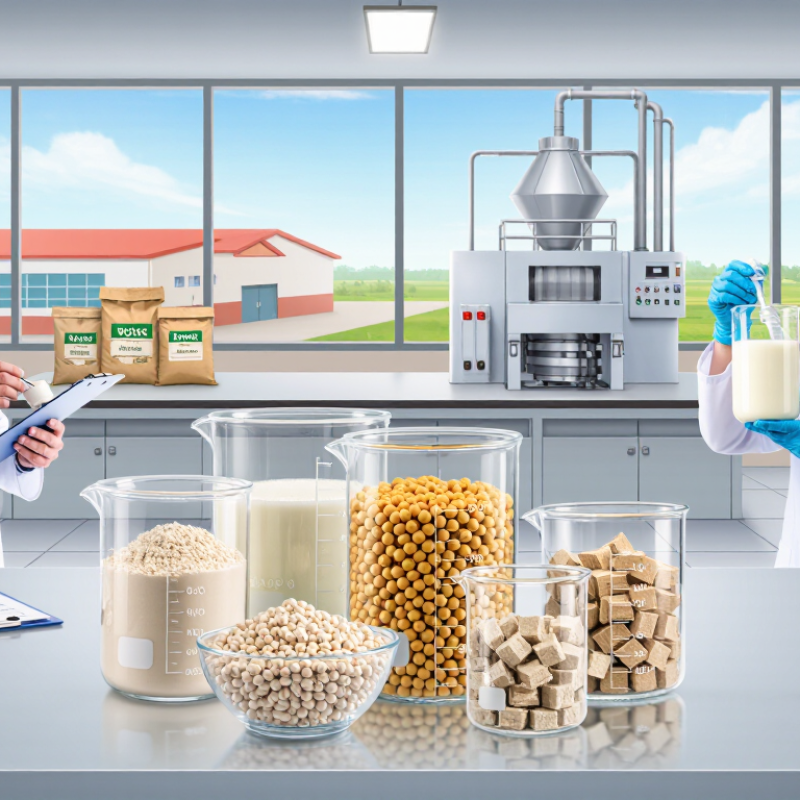
Before contacting suppliers in China, define the protein’s job in your product. Specify the source, such as soy, pea, wheat, or a blend, and set a minimum protein level on a dry-weight basis. State whether you need powder, concentrate, or isolate; these forms differ in protein content, flavor, and water absorption. Give suppliers a target particle size and moisture limit, too. A fine powder may disperse well in a drink but behave poorly in a meat-style filling. That matters. The FAO’s 2013 report, Dietary Protein Quality Evaluation in Human Nutrition, recommends assessing protein quality through digestible indispensable amino acids, not crude protein alone. Ask for amino-acid and digestibility data, and clarify the test method.
Set practical acceptance criteria before comparing samples: color, aroma, solubility, viscosity, and performance after heating. Request a recent certificate of analysis, batch traceability, and details of the crop’s origin and processing. Compare results using the same methods; supplier figures may not be directly comparable. Easy to overlook. The Good Food Institute’s 2023 State of the Industry report estimated global plant-based meat retail sales at US$6.4 billion, showing the category’s commercial scale, but that figure does not define your technical needs. Test samples in your actual recipe, using your water, salt, and mixing process. Record what fails, not just what tastes good. A sample can look excellent in a cup and turn gritty in a finished product.
China’s protein supply is regional, so match the crop to the ingredient’s intended use. USDA Foreign Agricultural Service’s 2024 China Oilseeds and Products Annual estimated 2024/25 soybean production at about 20.7 million tonnes. Heilongjiang and neighboring northeastern provinces are key origins. For soy protein, ask suppliers to document crop origin, protein content, and processing method. Isolate can suit clear drinks; textured soy may work better in savory products. Small details matter.
Pea protein has a different sourcing map. Gansu and Qinghai in the northwest, alongside Yunnan and Sichuan, are established pea-growing areas. The exact origin can vary by harvest and supplier, so request lot-level traceability rather than relying on a province name alone. China’s National Bureau of Statistics reported 20.65 million tonnes of soybean output in 2024, a useful cross-check against the USDA estimate. Still, crop volume does not prove ingredient consistency. Test samples for taste, solubility, and batch variation. Ask for recent certificates of analysis and confirm whether they cover the actual production site. One caution: supplier documents can look complete while leaving the crop origin unclear. Check that point directly.
When sourcing plant-based proteins from China, evaluate the supplier’s process, not just its product sheet. Ask how soy, pea, or other raw materials are received, identified, and traced through production. Review recent audit records, batch documents, and corrective-action reports. A factory tour can reveal practical details: clean storage areas, labeled sample jars, and clear separation between production lots.
Check capacity against your forecast, including peak demand. Ask how many lines and shifts are available, what maintenance can interrupt output, and whether raw-material supply changes by season. Request production records for comparable orders, not only the facility’s maximum capacity. Small details matter. A polished presentation is useful, but it cannot confirm consistent delivery. Paperwork may also look stronger than a rushed production week.
Define quality requirements before comparing quotations. Specify protein content, moisture, particle size, color, flavor, and functional performance in your intended recipe. Request certificates of analysis for several recent batches, then verify selected results through independent testing. Include microbiological and contaminant checks appropriate to the product and market. Sample the protein in a real application; a powder that disperses well in water may behave differently in a beverage or meat alternative. Some variation is normal, but unexplained variation deserves follow-up. Keep written acceptance limits and agree how out-of-specification batches will be handled.
Practical sourcing scorecard for comparing suppliers. Protein-content figures below are indicative ranges for common commercial ingredient types; confirm the exact specification, test method, and acceptance limits for each product.
| Evaluation Area | Product or Checkpoint | Indicative Data or Buyer Requirement | Evidence to Request | Evaluation Guidance |
|---|---|---|---|---|
| Product and Specification Comparison | ||||
| Protein source | Soy protein isolate | Typically around 90% protein or higher on a dry basis, depending on the grade and test method. | Current technical data sheet, batch certificate of analysis (COA), and test-method details. | Check protein content, moisture, color, flavor, solubility, and whether the ingredient is suitable for the intended food application. |
| Protein source | Pea protein isolate | Commonly about 80–85% protein on a dry basis; commercial specifications vary. | COA showing protein basis and method, plus sensory and functionality specifications. | Assess beany flavor, dispersibility, texture, and performance in the target formulation. |
| Protein source | Rice protein | Commercial protein ingredients are often specified at roughly 80% protein or above; grade and processing affect the result. | Product specification, COA, amino-acid profile if relevant, and allergen statement. | Check flavor, particle size, solubility, and whether the protein is an isolate or another grade. |
| Protein source | Fava bean protein concentrate | Concentrate grades commonly have lower protein content than isolates; request the supplier’s guaranteed minimum and basis. | COA, ingredient composition, processing description, and product-specific specification. | Compare protein level and functional performance on a like-for-like basis rather than by ingredient name alone. |
| Specification control | Moisture, ash, and microbiology | Limits should be agreed in the purchase specification and verified for each lot; there is no single limit that applies to every plant protein product. | Lot-specific COA, sampling plan, laboratory methods, and out-of-specification procedure. | Confirm that limits match the destination market, product application, and customer requirements. |
| Traceability | Raw-material origin and lot tracking | Require traceability from incoming raw materials through processing, packing, and shipment. | Traceability procedure, sample lot records, and a mock recall or trace exercise summary. | Check that the supplier can identify affected lots and provide records within an agreed response time. |
| Supplier Capability and Production Capacity | ||||
| Manufacturing role | Factory or trading supplier | Identify whether the seller manufactures the ingredient, subcontracts production, or trades finished goods. | Manufacturing-site details, process flow, site audit records, and subcontractor disclosure where applicable. | Confirm who controls production, quality release, change management, and complaint investigation. |
| Production capacity | Monthly available output | Request current available capacity in metric tons per month for the exact product and grade. Capacity is site- and product-specific. | Production-line details, recent output records, utilization, planned maintenance, and allocation commitments. | Compare verified available capacity with forecast demand; distinguish nameplate capacity from deliverable capacity. |
| Supply continuity | Lead time and peak-season planning | Obtain quoted lead time for samples, trial orders, and repeat commercial orders, plus a seasonal supply plan. | Recent delivery records, production schedule process, raw-material sourcing plan, and contingency plan. | Check whether lead times include testing, packaging, export documentation, and transport preparation. |
| Order flexibility | MOQ and packaging options | Request the minimum order quantity, standard pack size, pallet configuration, and options for a trial order. | Written quotation and packaging specification for the requested grade. | Compare total landed cost and inventory risk, not just the quoted unit price. |
| Change control | Formula, process, or site changes | Require advance notification and buyer approval for changes that may affect product identity, quality, safety, or compliance. | Documented change-control procedure and examples of customer notifications. | Include notification and requalification requirements in the supply agreement. |
| Quality, Food Safety, and Import Readiness | ||||
| Food-safety system | Hazard analysis and preventive controls | Verify a documented food-safety management system appropriate to the facility and product. | Current audit or certification documents, scope, site address, and corrective-action records. | Check validity, scope, issuing body, and whether the certificate covers the actual manufacturing site. |
| Product testing | Contaminants and microbiological risks | Agree risk-based testing requirements for the product, raw materials, and destination market. | Recent test reports from competent laboratories, methods, sampling details, and corrective actions for failures. | Ensure reports correspond to the supplied product and are recent enough for the purchase decision. |
| Allergen management | Cross-contact and label declarations | Confirm declared allergens, shared-line controls, cleaning validation, and cross-contact communication. | Allergen matrix, cleaning procedure, validation records, and product label information. | Assess against the rules and labeling needs of the intended destination market. |
| Regulatory fit | Destination-market compliance | Verify ingredient status, permitted use, labeling, and import-document requirements for the target country or region. | Product composition, specifications, origin documents, and supporting compliance declarations. | Obtain market-specific review before ordering; requirements vary by jurisdiction and application. |
| Sample qualification | Laboratory and application trial | Test representative samples for specification, sensory properties, and performance in the intended formulation. | Sealed sample with lot identification, sample COA, and agreed trial protocol. | Approve the product only after the sample and production-lot specifications are shown to be consistent. |
| Commercial review | Supplier comparison | Score each supplier on specification fit, verified capacity, quality systems, delivery reliability, and total landed cost. | Completed supplier questionnaire, audit findings, quotations, sample results, and reference shipment records where available. | Use the same criteria and scoring weights for every supplier, and document any unresolved risks before approval. |
Note: Product ranges are indicative, not guaranteed specifications. Protein values can differ by grade, moisture basis, analytical method, and supplier specification. Confirm all values using an agreed test method and a lot-specific COA before purchase.
When sourcing plant-based proteins from China, verify each certificate directly with its issuing body. Check the facility name, product scope, and expiry date. A certificate for one site may not cover another. Ask for a current food safety certificate and details of the supplier’s hazard-control system. Confirm that it applies to the actual production line, not just the company’s office. Small details matter.
Request batch-specific documents, including a certificate of analysis, microbiological results, and allergen information. For powders, compare the lot number on the report with the number on the sample bag. Check whether testing methods and limits fit your product and destination market. A neat file can still create false confidence. No checklist catches everything, and a result from one batch does not guarantee the next.
Before shipment, review import rules for your country with a qualified customs broker or food compliance specialist. Requirements may cover ingredient names, language, nutrition data, traceability, and supporting documents. Confirm labels and invoices match the product specification. Keep records of approvals and supplier responses. If a document is unclear, pause and ask for clarification; it is better to delay a shipment than guess.
Agree on the product before agreeing on the price. Put protein content, moisture, microbiological limits, allergen status, packaging, and test methods in the contract. Specify whether each shipment needs a certificate of analysis and retain a sealed reference sample. Define rejection thresholds, replacement timelines, and who pays for retesting. Small details matter. A vague “food-grade” clause is not enough.
Set the delivery term and named destination clearly, then assign responsibility for insurance, export documents, port charges, and delays. UNCTAD’s Review of Maritime Transport 2024 reports that over 80% of world trade by volume moves by sea, so port disruption can affect even well-planned orders. Build buffer time into production schedules. For sensitive ingredients, ask how liners, seals, and moisture barriers protect bags during transit. The World Bank’s Logistics Performance Index 2023 evaluates customs, infrastructure, tracking, and timeliness; use these areas to frame supplier questions, not as a guarantee of performance.
Reduce supply risk by qualifying a second source and requesting lot-level traceability before scaling orders. FAO’s 2019 State of Food and Agriculture estimated that 14% of food is lost between harvest and retail globally. That figure is not specific to protein powders, but it underlines why handling and storage records matter. I still treat a perfect delivery forecast with suspicion. Review actual lead times after each shipment, and adjust reorder points when port or production schedules shift.
Heilongjiang and nearby northeastern provinces are key soybean origins. Ask suppliers to document crop origin and processing method.
Gansu, Qinghai, Yunnan, and Sichuan are established pea-growing areas. Origins can vary by harvest, so check each lot.
Soy isolate may suit clear drinks. Textured soy may work better in savory products. Test the intended use.
Request a certificate of analysis, microbiological results, and allergen information. Match the report’s lot number to the sample bag.
Verify each certificate with its issuing body. Check the facility name, product scope, and expiry date. Small details matter.
Not necessarily. Confirm that the certificate applies to the actual production line, not just the company office.
Test taste, solubility, and batch variation. Ask for recent results from the actual production site. One sample is not enough.
Check destination-market requirements with a qualified customs or food compliance specialist. Confirm labels and invoices match the product specification.
No. Documents can leave crop origins unclear, and one batch result cannot guarantee the next. I would still double-check.
Sourcing plant-based proteins from China begins with clearly defining your product requirements, including the intended food application, protein content, texture, flavor, processing needs, and target price. These details help narrow the options, which may include soy, pea, wheat, rice, or other plant proteins, and guide you toward suitable production regions and supply chains.
To understand how to source vegetal proteins for food production, compare suppliers on manufacturing capacity, consistency, traceability, and quality controls. Review relevant certifications and request product specifications, test results, and samples before making a decision. Confirm that the selected ingredients meet the food safety and import requirements of your destination market. Finally, agree on pricing, minimum order quantities, payment terms, packaging, and delivery schedules, while planning for shipping delays, quality variations, and other supply risks. A structured evaluation helps support reliable purchasing and long-term supply.

Entry Biology