Plant proteins are no longer niche ingredients; they are becoming structural tools for modern food design. The Good Food Institute reported that U.S. plant-based retail food sales reached approximately $8.1 billion in 2023. That growth raises a practical question: how do vegetal proteins affect food texture? In products such as burgers, yogurt, and meat alternatives, texture often determines whether consumers return after the first bite.
Proteins from soy, pea, fava bean, wheat, and potato behave differently during hydration, heating, mixing, and shearing. Soy can form elastic gels, while pea protein may create firmer but sometimes gritty structures. Wheat gluten provides stretch and chew, especially in plant-based meat. These effects depend on concentration, particle size, pH, oil content, and processing temperature. Small changes can turn a smooth emulsion into a dry, crumbly bite.
Industry research supports this technical focus. Innova Market Insights has repeatedly identified texture and mouthfeel as major drivers in plant-based product development. The Institute of Food Technologists also emphasizes protein functionality, water binding, and gel formation as essential quality factors. However, market reports often measure launches and sales, not the complete sensory experience. That limitation matters. A product can show strong protein content yet feel chalky or rubbery.
This article examines the scientific and commercial role of plant proteins in texture. It connects ingredient chemistry with real manufacturing decisions, from blending pea isolate into a pale sausage mixture to creating spoonable, stable plant-based yogurt. The conclusions are useful, but not absolute. Protein performance changes across formulations, and even expert assumptions require sensory testing.
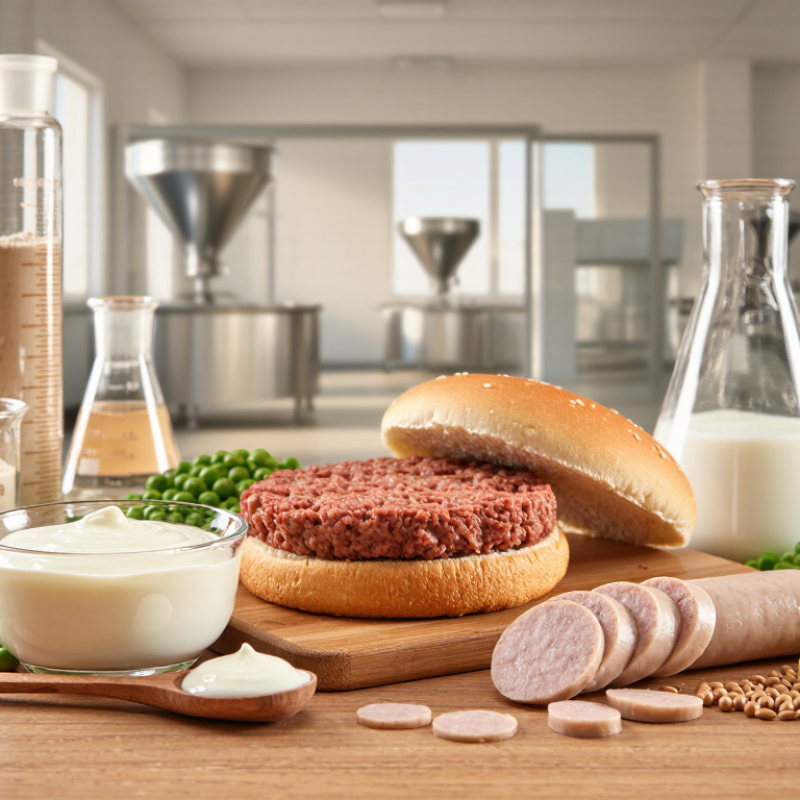
Plant proteins are concentrated nutrients found in legumes, grains, seeds, and some vegetables. They include molecules such as globulins and gluten-forming proteins, each behaving differently in food. Their structure helps determine whether a product feels creamy, springy, flaky, or dry. Protein matters beyond nutrition. It also acts as a working ingredient. In a bowl of chickpea batter, hydration softens particles and allows proteins to connect during heating. Small changes matter. Too little water leaves a gritty bite; too much can create a weak, wet crumb.
Food texture depends on several protein actions. When heated, proteins unfold, then join into a network that can hold water and oil. This process is called denaturation and aggregation. In plant-based foods, protein networks may also trap air, stabilize emulsions, or form gels. Pea and soy proteins can create firmness, while oat or rice proteins often behave differently because their solubility and composition vary. Processing changes the result. Grinding, fermentation, pressure, and extrusion can make proteins smoother or tougher. Texture is not automatic.
A practical kitchen test reveals this clearly. Blend soaked lentils, cook the mixture, and compare it with an untreated puree. The cooked sample usually feels thicker and more cohesive. Yet it may taste pasty if the protein network holds too much water. That is an important limitation. Formulators must balance protein level, particle size, moisture, fat, and heating time. I would not treat “more protein” as a guaranteed texture improvement. Results depend on the whole recipe, and small trials can mislead when scaled up. Better evaluation includes spoon resistance, bite, moisture release, and texture after cooling.
| Plant Protein Source | Major Protein Components | Typical Protein Content* | Main Texture-Forming Functions | How Texture Is Created or Improved | Common Texture Challenges | Suitable Food Applications |
|---|---|---|---|---|---|---|
| Soybean | Globulins, especially glycinin and β-conglycinin | Approximately 35–40% of dry seed weight | Gelation Emulsification Water binding Foaming | Heating unfolds the proteins, allowing them to aggregate and form elastic or firm networks. High-moisture extrusion can align the proteins into fibrous structures. | Beany flavor, possible firmness or rubberiness, and sensitivity to processing conditions. | Tofu-style gels, meat alternatives, emulsified foods, beverages, baked foods, and protein-rich snacks. |
| Pea | Legumin and vicilin | Approximately 20–25% of dry seed weight | Water binding Gelation Emulsification | Protein concentrates and isolates absorb water and can form heat-set gels. Extrusion promotes a denser, meat-like structure when moisture and shear are controlled. | Chalky or gritty mouthfeel, limited solubility near the isoelectric region, and noticeable earthy or green notes. | Plant-based meat, dairy alternatives, nutritional beverages, soups, bakery products, and formulated snacks. |
| Wheat | Glutenin and gliadin | Approximately 10–15% of whole wheat grain; much higher in separated gluten | Viscoelasticity Elasticity Gas retention | Hydration and mixing create a gluten network. Glutenin contributes elasticity, while gliadin contributes extensibility and flow. | Not suitable for people with celiac disease or wheat allergy; can produce a chewy or dense texture if poorly formulated. | Bread, noodles, seitan-style products, meat analogues, and structured dough systems. |
| Chickpea | Primarily globulins, including legumin and vicilin | Approximately 18–22% of dry seed weight | Thickening Water binding Emulsification | Hydrated chickpea proteins and associated carbohydrates increase viscosity and help stabilize dispersed fat and water phases. | Potentially coarse or pasty texture, lower protein solubility than some purified isolates, and legume flavor. | Hummus, patties, batters, pasta, baked foods, spreads, and plant-based fillings. |
| Fava bean | Globulins, mainly legumin and vicilin-like proteins | Approximately 25–32% of dry seed weight | Gelation Foaming Emulsification | Heat and concentration can produce protein networks. The proteins can stabilize air cells and oil droplets when adequately hydrated and processed. | Bitterness, green or beany notes, and possible dryness in low-fat formulations. | Meat alternatives, whipped toppings, baked products, protein powders, and snack foods. |
| Potato | Patatin and protease inhibitors | Approximately 1.5–2.5% in fresh potato; concentrated ingredients contain substantially more | Emulsification Foaming Gel support | Potato proteins can stabilize oil-water interfaces and air bubbles. Their functionality can complement starch, which supplies body and viscosity. | Low protein concentration in the raw material and possible loss of functionality during severe heating or unfavorable pH conditions. | Egg replacers, sauces, bakery products, foams, dressings, and composite plant-protein foods. |
| Rice | Glutelin and prolamin fractions | Approximately 7–9% of dry grain weight | Water binding Body formation Mild flavor | Rice proteins contribute solids and water absorption, while rice starch commonly supplies viscosity and cohesive structure in the final product. | Relatively low solubility, limited elasticity, and a tendency toward dryness or powderiness when used at high levels. | Gluten-free bakery products, beverages, cereals, nutrition bars, and blended plant-protein formulations. |
| Oat | Avenins and globulins | Approximately 11–17% of dry grain weight | Creaminess Viscosity Water binding | Oat proteins work together with soluble fiber, especially beta-glucan, to increase viscosity and create a smooth, creamy mouthfeel. | Low elasticity, possible grittiness after insufficient processing, and texture changes caused by starch or fiber interactions. | Plant-based drinks, porridges, yogurt-style products, bakery foods, and creamy sauces. |
| Lupin | Globulins, including α- and β-conglutin | Approximately 30–40% of dry seed weight | Emulsification Foaming Water binding | Its proteins can improve cohesion and help stabilize emulsions and foams when hydrated and dispersed effectively. | Legume flavor and allergen concerns; processing must control particle size and hydration to avoid a rough mouthfeel. | Bakery products, pasta, meat alternatives, spreads, and high-protein snacks. |
Functional properties matter more than protein content alone. Solubility, water binding, gelation, and particle size shape the final bite.
Well-dispersed protein creates a smoother texture. Poorly dissolved particles may feel gritty, even after fine milling.
Yes, strong water binding can support softness during heating. Too much bound water may create a heavy or pasty structure.
Heat can unfold proteins and form a firmer network. Salt and acidity may strengthen or weaken that network.
Hydration softens the protein, while shear aligns it into layers. Controlled heating then strengthens those layers.
Too little moisture can create a dry, rubbery bite. Too much may produce a weak, sponge-like structure.
Cooling can tighten the protein structure. A sample may feel tender at 80°C, then become firmer in a refrigerator.
Beverages need good hydration to avoid grit. Bakery foods benefit from water retention, while snacks use proteins for crispness.
No. Instruments measure firmness, but trained tasters notice chewiness, adhesiveness, and breakup. Neither method is perfect.
Test mixing time, moisture, particle size, and heating conditions. Check the product after storage and reheating. Small changes can matter.
Plant proteins are essential building blocks in food design because they help determine structure, firmness, elasticity, and overall eating quality. So, how do vegetal proteins affect food texture? Their impact depends on characteristics such as water absorption, solubility, emulsification, gel formation, and the ability to bind with other ingredients. When hydrated and properly processed, plant proteins can create cohesive networks that provide thickness, chewiness, softness, or a meat-like bite. Their performance is also influenced by concentration, particle size, pH, heat, and interactions with starches, oils, and fibers.
Processing methods can significantly modify protein-driven texture. Heating may strengthen protein networks, while mixing, extrusion, fermentation, and drying can change density, moisture retention, and elasticity. These properties allow plant proteins to be used across many food categories, including beverages, baked goods, meat alternatives, dairy-free products, snacks, and structured foods. By selecting suitable protein sources and controlling processing conditions, manufacturers can develop textures that are stable, appealing, and appropriate for different product applications.

 Entry Biology